

Discovering new biomarkers in cancer with a phenotype first approach
Uncover disease-defining biomarkers by starting with cellular phenotypes, not predetermined targets.

Why do we need new biomarkers?
Traditional biomarker discovery relies on testing predetermined targets from existing literature. This target-first approach often misses what truly defines disease states, creating a bias toward known targets that can lead researchers down ineffective development paths, wasting years validating biomarkers that sound promising in theory but fail in clinical practice.
A new generation of biomarkers requires a fundamentally different approach. This approach means starting with what matters most, which is the actual phenotypic differences between healthy and diseased cells. Rather than forcing preconceived targets onto disease models, phenotype-first discovery lets cells reveal their own defining characteristics.
For diagnostics, this unbiased approach identifies biomarkers that actually reflect disease biology, enabling more accurate grading and staging of conditions like cancer. For drug development, it uncovers targets for receptor-mediated endocytosis, drug resistance mechanisms, and therapeutic delivery pathways that remain invisible to traditional target-first thinking.
Case study: Oesophageal cancer biomarker discovery
Our phenotype-first biomarker discovery process was applied to oesophageal cancer, where existing markers showed insufficient discrimination between disease stages. Rather than testing another predetermined target, we let the cancer cells themselves guide discovery.
Starting with real disease phenotypes: Low-grade and high-grade oesophageal cancer cells, plus closely-related squamous cancer cells, were used to drive unbiased Optimer generation against undefined cell surface biomarkers.
Phenotype-driven selection: Through positive screening for target cells and negative screening against non-target cells, three highly specific Optimers were developed without bias toward any predetermined targets.
Results: Three distinct Optimers emerged, each binding specifically to one cancer type. The underlying biomarkers can now be identified through downstream proteomic analysis when required for further research or therapeutic development.
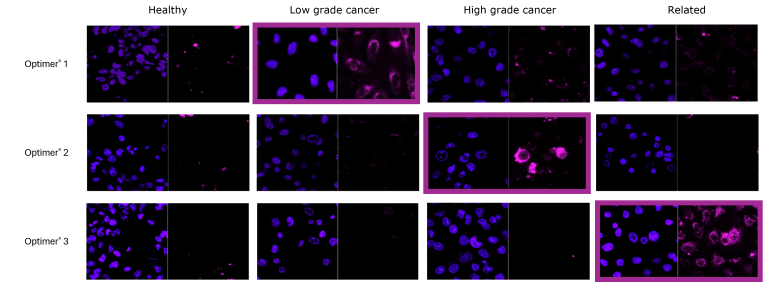
Phenotype-first discovery identified three distinct biomarkers for oesophageal cancer staging. Optimer specificity highlighted in purple on each sample (Violet = labelled Optimer; blue = nuclear stain).
How do we carry out phenotypic discovery for new biomarkers?
Breaking free from target bias: Instead of starting with predetermined targets from 10-year-old papers, our biomarker discovery service begins with cellular phenotypes—cancer vs healthy, resistant vs sensitive, activated vs quiescent. This phenotype-first approach eliminates researcher bias and reveals biomarkers that actually define disease states.
Rather than beginning discovery for binders using a known target, phenotypic discovery compares cell phenotypes, for example, healthy vs diseased, or cardiomyocytes vs pericytes and fibroblasts. An Optimer library is screened against the various cell types with positive screening for the target cell type and negative screening removing binders that stick to the non-target cell types. This drives Optimer selectivity to the desired cell type without favouring any specific biomarkers.

Selective Optimers are developed from phenotypic discovery against undefined cell surface biomarkers. Target biomarker identification can then be carried out post-discovery using proteomic techniques like mass spectrometry with functional analysis via selective pathway inhibition, delivering new biomarker insights and the required binders needed to study and validate the biomarker in downstream applications. Because these Optimers emerge from real phenotypic differences, they provide a reliable foundation for further biomarker validation when required.
Why phenotype-first biomarker discovery outperforms traditional approaches
Our biomarker discovery service offers distinct advantages over target-first methods:
- Unbiased target identification reveals biomarkers invisible to traditional literature-based approaches
- Disease biology-driven discovery ensures biomarkers reflect actual disease states, not researcher assumptions
- Faster validation because biomarkers emerge from real phenotypic differences
- Accurate target conformation optimised for cell and tissue-based applications
- Versatile binding characteristics can select for surface binding, internalisation, or specific organelle delivery
- Overcomes target bias that limits conventional approaches to known, often ineffective targets
Ready to discover what your disease models are revealing? Our biomarker discovery service identifies the targets that truly define your phenotypes, whether you need diagnostic biomarkers or therapeutic delivery targets.